


A friend once applied for a job she was SO excited about, only to start the interview process and notice that things seemed a little…off.
The process itself felt scattered and disorganized. But then they mentioned how fast they were growing, and my friend thought, well, that’s why they need this role filled! It took ages to hear back after each interview stage, but everyone she met said something about how busy they were, so the long gaps in communication made complete sense. The person she was supposed to report to changed depending on who she talked to, but they’d mentioned a couple of reorgs, so it tracked that they were still figuring things out. Different leaders gave her completely different descriptions of the company culture, but culture is subjective, right?
For privacy reasons, let’s call that friend Jen. Okay fine. It was me.
I’d like to believe I can be an objective, rational decision-maker, and that I carefully weigh evidence before reaching thoughtful conclusions. In reality, when I’m really excited about something, I turn into a very creative storyteller. This isn’t so much about ignoring contradictory evidence as it is reinterpreting it.
By the time I accepted the offer, I’d become completely convinced that every weird interaction was the result of what happens in a rapidly scaling company, which, in hindsight, wasn't wrong…just incomplete.
Over the following months, things that had seemed strange but isolated during the interview process began to look much less isolated as the patterns became harder to miss. The communication that had seemed inconsistent during recruitment became chronic once I joined. The leaders who’d described the organizational culture so differently weren’t offering unique perspectives…they were running their own micro-organizations inside the larger one, with very different values, rules, and expectations.
I’d spent the interview process treating each weird interaction as something that needed its own explanation, when together they were telling me something about the organization itself. I’d been looking for reasons to dismiss the inconsistencies when I should have been getting curious about what they had in common. The organization had been giving me information from the beginning. I just didn’t know what to do with it.

Follow The Work
Anyone working in Human Resources is used to being told their value will come from increasing their business acumen. It’s true. You should understand how the organization makes money, who its customers are, what it sells, its economics, etc., but learning the business and learning the organization are different capabilities.
You can understand the revenue model and still have no idea why a relatively simple decision takes three weeks. You can know the competitive landscape and still have no idea why everyone consults the same person before making a decision, even though nothing on the org chart suggests they should.
The business is what the organization is trying to do. The organization is the human system through which it is attempting to do it.
Ideally, there are already experts in most parts of the business: Finance → economics, sales → customers, product → product, and so on. HR needs enough understanding of all of those things to work intelligently across them, but becoming a worse version of the CFO has never struck me as where HR can add the most value.
Know what hardly anyone is explicitly taught to become an expert in? Reading the organization.
In mysteries, when detectives are trying to solve a crime, they always “follow the money.” Instead of relying on what people say happened, they trace something concrete and see where it leads.
You can read organizations pretty much the same way, except instead of following the money, you need to follow the work.
Imagine your company tells you it values autonomy. You could debate whether that’s true, ask employees whether they feel empowered, look at where decision rights sit on the org chart. But you could also just…follow a decision.
Someone encounters a problem. Then what? Can they decide what to do about it? Do they ask their manager? Does someone call Vinny, who hasn’t worked there in three years, to see what he would do? Does Legal get involved? Finance? Does everyone wait until Thursday’s leadership meeting? Does somebody eventually just make a call?
That one decision won’t tell you everything about autonomy in the organization, but it will give you some pretty strong evidence. Follow enough decisions, and you start to see what authority really looks like in practice.
The same goes for collaboration. Follow a workflow that crosses departments. Watch what happens when Sales hands something to Operations, or when an exec's decision has to make its way to the people expected to implement it. What information travels with the work? What gets lost? Who gets consulted early and who doesn’t? Where does the work stall? Who's built a sidestep that makes the whole thing move faster? Is there one surprising person who keeps getting looped in?
Autonomy and collaboration are real things we can watch happen…or not, in the movement of actual work.
ACTION → Pick up a thread and follow it
A decision, a request, an approval, an idea…it doesn’t really matter what it is. Just make sure to stay with it and see it through from start to finish.
This is the clue-gathering stage.
Get Close
One of the easiest ways to misread an organization is to study it from too far away. A project can go through six weeks of complicated delays, decisions and dependencies, but by the time the information reaches someone a few layers removed from the work, most of that context has disappeared.
Distance compresses information. The further we move from the work, the more detail gets stripped away so information can travel. What do I mean by that? Six messy weeks become a red arrow pointing down on a PowerPoint slide.
Compression is necessary…no one can run an organization by personally observing everything that happens inside it. But something is always lost in the process.
Donella Meadows put it this way: “Before you disturb the system in any way, watch how it behaves.” Problems often reach us already compressed into a metric, a complaint, an executive concern or a proposed solution, and we start discussing what to do about it before spending much time looking at what is actually happening.
So we need to get closer while remembering that proximity comes with its own limits. The person closest to the work has a view the rest of us don’t, but they still only have a view. Every vantage point reveals something and obscures something else. Proximity gives you information, not omniscience.
ACTION → Get closer
When what you can see doesn’t fully explain what’s happening, ask who’s closer to it than you are. Then go see what becomes visible from there.
Make the Most of Fresh Eyes
If you’re new to an organization, you have a temporary advantage in that things still look strange. You aren’t yet immune to the company's quirks.
Maybe you've attended a few team meetings and noticed that, out of the twelve attendees, two never ever speak. Or maybe you’re frustrated because you have to enter the same information into two different systems. Or maybe you don’t understand why everyone copies Priya on emails that don’t seem to have anything to do with her.
Fast forward three months, and…
You’ve learned that the two employees who never speak during team meetings are used to their ideas getting shut down. You’ve learned that you have to enter information into two different systems because one team insists on using System A while another refuses to give up System B, so everyone has adapted to keep the peace. And you’ve learned that Priya gets copied on everything because everyone trusts her to catch what they’ve missed.
While this knowledge makes you more effective, it also makes you less capable of seeing what you, and everyone else, has adapted to.
Fast forward six months. A new employee asks why everyone cc’s Priya, and it’s a pretty safe bet you answer with, “Oh, that’s just what we do.”
Poof…something that once struck you as strange has officially crossed the border into normal.
I think this is one of the greatest missed opportunities of onboarding. We’re basically trying to help new employees stop being confused when some of their confusion is incredibly valuable information! A new employee asking why we do it this way may simply be missing context, AND they may be seeing something everyone else stopped noticing five years ago.
ACTION → Make the familiar strange again
If you’re new, start a running list of the things that surprise or confuse you before the organization rationalizes them out of existence.
If you’ve been around a while, borrow someone else’s eyes. Ask a newer employee what surprised them. Sit with a different team. Follow a process you’ve only ever dealt with the end result of. Ask someone to show you how they actually do work you think you already understand.
If you have a say in designing the onboarding process, use it to capture what new employees can see while they can still see it. It’s not uncommon for companies to send a post-onboarding survey to new hires, but the questions tend to focus on improving the onboarding experience itself. Ask about the organization, too: What seemed strange when you first arrived? What surprised you about how work gets done here? What questions did you ask that were answered with, “That’s just how we do it here”?
The In Between
If you don’t know where to look, start with the in between.
Handoffs
Handoffs are where assumptions collide and information gets lost. Watch what happens when a customer moves from sales to implementation, or when recruitment hands someone to a hiring manager.
What travels with the work? What has to be explained again? What shows up after? Where does someone have to nudge, chase, or escalate? Where does ownership disappear? Who makes sure the handoff is successful?
That last one is especially useful because organizations are full of people who spend enormous amounts of time and energy in the spaces between formal structures. They’re the ones who remember to tell the other team, or translate the exec’s request into something people can action. They know who needs a heads-up, or notice the missing information before it leads to a catastrophe.
Workarounds
I once, very briefly and under strict confidentiality, laid eyes on a secret spreadsheet because the official system didn’t provide the information people needed. Sometimes, an entire department is doing something completely different from the formal process because they think it’s the only way anything will get done on time.
When you find a workaround, resist the urge to start with the fact that people aren’t following the process. Start with why instead: What problem is the workaround solving?
Bottlenecks
Bottlenecks seem easy to spot because we tend to imagine them as work coming to a crawl. And while sometimes that’s true, they can also show up as a surge of activity.
Bottlenecks can look like one document with ten people’s fingerprints all over it, or a small decision getting airtime at four different meetings. Maybe it’s the pre-meeting for the meeting and the follow-up meeting after the meeting. Everyone is extremely busy, and the work is technically moving, but somehow not getting anywhere.
As you follow the work, look for where it slows, loops, expands, changes course. Then get curious about what’s happening there: What is making it so difficult for the work to flow?
ACTION → Look between things
As you follow your thread, pay attention to the handoffs, workarounds and bottlenecks. Where does someone have to nudge, chase, translate, rescue, improvise or go around something to keep the work moving? Where does it slow down or loop back? What are people doing to make the work work?
Study the Exceptions
Imagine three teams use the same process, but one consistently moves through it faster. Or everyone tells you that Sales and Operations can’t work together except for one salesperson and one operations lead.
It could be that the fast team has developed a practice the other teams aren’t aware exists. And maybe two people built a communication system that allows work to cross a silo with very little friction.
Or maybe it’s luck! You don’t know yet. You’re looking for the exception because the exception is where you’ll find the information.
ACTION → Find the exception
Look for where this keeps happening, where it doesn’t, and what’s different there.
Show, Don’t Tell
Years ago, there was a video going around of a dad who asked his kids to write down instructions for making a peanut butter and jam sandwich, then filmed himself following their instructions exactly as written. As expected, the results were chaotic. An instruction like “Put the peanut butter on the bread” ends up with the dad putting the jar of peanut butter on top of the loaf of bread. While the kids know how to make a PB&J sandwich, their instructions leave out all kinds of essential information they don’t realize needs to be spelled out.
The video is a version of an exercise that’s been used for years to teach things like programming and procedural thinking, where the whole point is to expose how much knowledge we unconsciously fill in when following instructions. It’s also a great demonstration of knowledge developed through experience: tacit knowledge, which can be difficult to fully articulate.
Ask a colleague how a process works, and they’ll probably give you a pretty decent description. Watch them do it, and suddenly, all sorts of things show up that they didn’t mention, like a person they always message first, a step they usually skip, or a judgment call they make.
So when you’re trying to understand how something actually works, watch it happen whenever you can. Sit in on the meeting. Follow the request. Ask someone to share their screen and take you through the process.
Of course, you can’t observe everything. Some things have already happened, happen infrequently, or aren’t really that observable. In those cases, get as close to the actual event as you can, which might mean changing the kinds of questions you ask.
Think about engagement survey questions…you can ask employees to rate cross-departmental collaboration on a scale of one to five, then maybe follow up with a few questions about why they gave that score. That’ll tell you something. Or you can walk on over to them and ask about the last time they needed another department’s help to get something done.
Now you have an actual event to investigate instead of a general impression of how collaboration works.
ACTION → Get concrete
When you can, watch the work happen. When you can’t, ask about a specific time it did. Stay as close as you can to what actually happened before moving into what someone thinks it means.
Why Yes You Should Buy a New Notebook!
If you’re anything like me, then you have a profoundly unhealthy addiction to buying notebooks. My gift to you is permission to go and get another one, because if you do only one thing while reading this series, it’s to start keeping field notes.
Dan Korus, whose question started this whole series, is a huge proponent of keeping journals and taking notes. In this case, writing things down captures what you notice before you get used to it and your brain starts filling in the why.
You can document whatever you want, but avoid writing conclusions.
For example, the following won’t work for what we’re trying to do with this series:
Leadership is controlling
Nobody communicates
People are afraid to disagree
For a burn book, sure, but as observations, they’re terrible.
Instead, try going full Attenborough. Imagine you’re narrating a workplace documentary and can only describe what your camera crew is capturing: “Here we see three managers, each apparently authorized to make the decision before them, independently seeking approval from the VP. Fascinating.”
Boring is good! Dates are good! Specifics are good! Things that contradict your emerging theory are especially good!
Three weeks from now, you won’t have to rely on your memory of whether something keeps happening. You can look at your notes and distinguish what you noticed once from what you’ve now recorded six times. You can notice that something you thought happened everywhere actually only happens under specific conditions. You can see where explanations and evidence don’t align.
You’re giving yourself receipts for your own thinking.
ACTION → Document the behaviour before you explain the behaviour
Record what happened, who was involved, and when. Be specific enough that you can come back later and separate what happened from what you thought it meant.
Your Theory Can Wait
Once you start following the work, patterns begin to emerge. Something you may have initially registered as a gut feeling starts becoming a thing you can actually point to. You might see it happen more than once, notice where it happens, who is involved, what changes under different conditions, and maybe even where the pattern disappears.
And somewhere along the way, your brain will probably start trying to explain it. You might develop a theory about why it keeps happening, or identify who’s responsible. If you’re anything like me, you may have redesigned the entire process in your head while someone is still explaining it to you! Thanks, brain.
If that’s happening, then write the explanation down. Write down what you’re already itching to fix, who or what you’re tempted to blame, and the recommendation that’s beginning to form.
Then leave it there.
Go back to what you actually observed. What surprised you? What repeated? Where did the formal version of the work and the lived version diverge? Whose knowledge changed your understanding? What became visible only after you got closer? What evidence doesn’t fit the explanation you’re currently leaning toward?
Then ask yourself: What do I think all of this means?
Write down your current answer, but hold onto it loosely, because the sticky part, the part where things usually go sideways, is that you were the one doing the looking, deciding what to follow, choosing who to ask. You noticed some things and missed others. And you brought your own history, expectations, assumptions and experiences along for the ride. Don’t forget that!
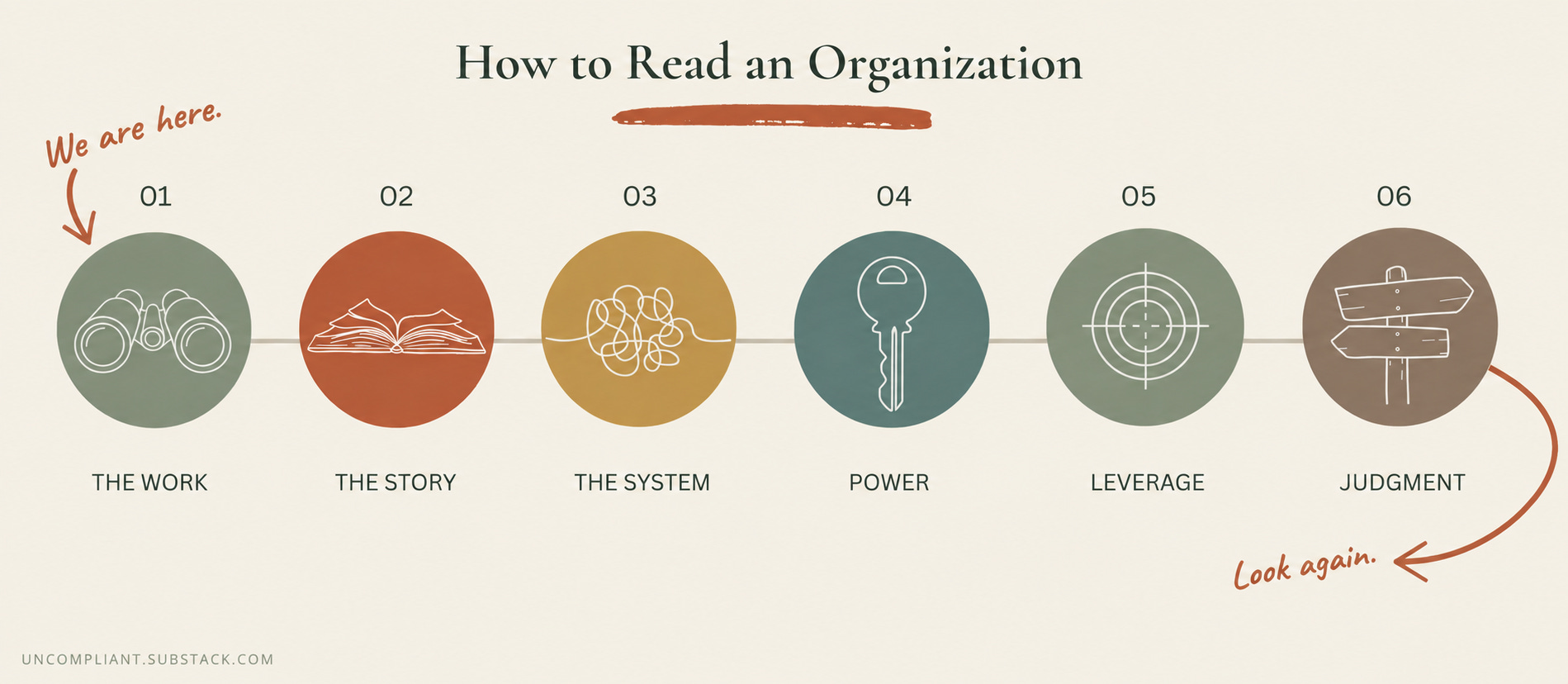
The whole point of following the work is to get closer to what is actually happening before deciding what it means. Which brings us to…
Part 02: THE STORY
What am I making this mean?
Want to take this into the field?
Part 01: The Work is available now in printable and fillable PDF versions. Paid subscribers get The Uncompliant Field Guide to Reading an Organization, a six-part companion to this series designed to help you investigate your own organization as you read.
Great post! I love the principle of trusting your gut but only acting on it once you have evidence, a rare art in my experience.
Also, follow the decisions to find the real power underneath the organization.